Renee had the strongest HR résumé in the stack.
Eight years in People Ops. A SHRM-SCP. Two HRIS migrations she ran without a hiccup. A Glassdoor rating she'd personally pulled from 3.4 to 4.6.
She made the final round for Head of People at a Series B company. Then she lost to a candidate with fewer years in HR.
The feedback came back gentle and a little crushing: "We loved Renee. The other candidate just felt more… strategic."
Renee didn't see that her résumé read like a list of responsibilities. Her LinkedIn was a stack of job titles she hadn't touched in a year. And when the panel said "tell us about yourself," she walked them through her career in order, start to finish. Three surfaces, all saying the same thing: experienced HR practitioner. None of them saying business leader.
The candidate who won said the second thing, differently and with increasingly compelling examples, everywhere they looked.
You're evaluated on three surfaces, in order
Before anyone extends a Head of People offer, they check three things, usually in this order:
- Your résumé decides whether you get shortlisted.
- Your LinkedIn is the gut-check they run the moment the résumé interests them.
- Your live story is what you say when they finally talk to you.
Hiring teams cross-reference all three. A sharp résumé can be undercut by a LinkedIn that list different positions. And, a great LinkedIn followed by a rambling "tell me about yourself" can raise a red flag.
The person who lands the role makes the same case on every surface: the outcomes they drove, the scope they've owned, and whether they communicate using business language or HR jargon.
1. The résumé: The written case
A CEO or founder isn't asking "Is this a good HR person?" By the time they're reading closely, that's assumed. They're asking, "Will this person move my company forward and will I see it in the numbers?"
A while back I posted the two changes I'd make to almost any résumé. It struck a nerve: 869 reactions and 308 comments. Here they are.
1. Give every company context. A recruiter shouldn't have to Google where you worked. Next to the company name, add the industry, the business model, the funding stage, and the size:
Column, Series A public-information software for media companies, law firms, and businesses.
That one line tells them how relevant your experience actually is.
2. Write accomplishments, not tasks. Use a simple formula: action verb + result + what you did. The result is the part most people skip, and it's the part that earns you the interview:
Increased satisfaction with pay transparency from 13% to 78% and moved 90%+ employees into pay bands with a compensation philosophy, job leveling framework, and pay data platform
Compare that to "managed compensation." Same work. Only one sounds like someone delivered a meaningful outcome.
Those two changes are the most-shared résumé advice I've ever given. The full structure, with a before/after line for every section, is in the template below. 👇
2. LinkedIn: Your career story
Your résumé proves your impact and shows the shape of where you've worked: company size, industry, how it was funded. LinkedIn does the part a résumé can't. It tells the story behind the moves.
When a CEO opens your profile, they're reading for motivation as much as experience. Were you recruited from one company to the next or did you apply cold? Did you follow a leader you believed in? What have you shared or commented on that hints at what you care about? Those signals tell them who you are and how you'll fit, in a way a bullet list never can.
A few things to get right:
- Make your headline name where you're headed, not just your current title.
- Let your "About" and role descriptions carry the why: the reason you joined, what you were brought in to do, what you took away.
- Keep posting when you have something real to say. A handful of posts that show how you think build more credibility and signal more expertise than a polished profile that's gone quiet.
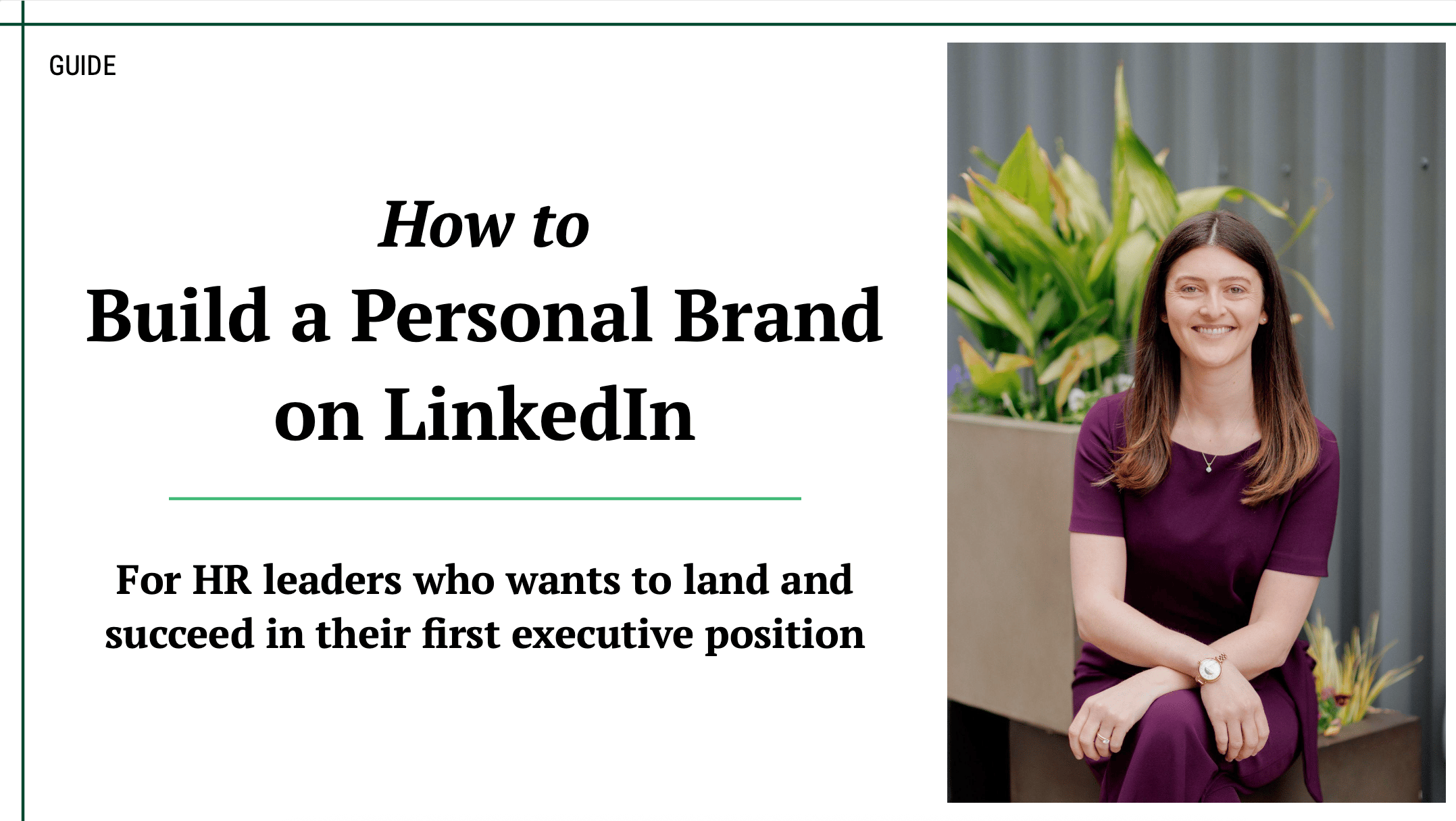
If you want the full walkthrough — how to write your "About," what to post, and how to make your profile read like a story instead of a job list — that's exactly what my LinkedIn Guide is for.
📘 The LinkedIn Guide for People Leaders
Turn your profile from a résumé clone into a career story that builds credibility and gets you found for the roles you want.
 |
$19.00
How to Build a Personal Brand on LinkedIn as an HR Leader
Want your LinkedIn to advance your career? This 14-page guide shows you how to turn your profile into a high-converting... Read more |
3. In the room: Your live story
The first conversation with a recruiter almost always opens with "Tell me about yourself."
I love a good chronological story here. The trick isn't to skip the timeline. It's to give the timeline a compelling arc, it should feel like it has direction.
To start, pick the one thing you want someone to remember about you. Your one simple thing (OST). Mine is: "I help take tech companies from startup to scale-up." Everything else in my story exists to reinforce that single line.
Lead with your OST, then walk them through your career in order, and make every role prove your OST claim. By the end, they don't just know your history. They know exactly what value you'll bring to their organization.
The Four-T Playbook
Every edition, I share a proven tip, trick, tactic, or template. This time, it's a:
👉 Template: The HR Resume Template. Start here, because once the written case is sharp, your LinkedIn and your live story have a script to follow. It's the same business-case structure I coach candidates through, with a before/after example line for each pillar.
Final thoughts
Tell one story, with increasing depth, breadth, and style, everywhere they look. Make it feel cohesive across your résumé, your LinkedIn, and the way you talk about yourself, and you'll walk into the interview already credible.
Which brings us to the room itself. Positioning is the case you bring in before anyone pushes on it. Interviewing is what happens when a panel of non-HR executives start asking hard questions. That's Part II: how to interview like a business leader, not the best HR person in the room.
I'd love to hear: which of the three surfaces is your weakest right now, your résumé, LinkedIn, or live storytelling? Hit reply. I read every one.
Until next time,
Melissa