How to model compensation for annual budgeting
September 29, 2026 | Edition #31
Hi there,
Did you know that in most remote SaaS companies, headcount expenses account for more than 70% of a company's annual revenue? (Source: Bain & Company OpEx Engine 2018)
While AI might change things, that number has remained relatively stable for years. (If you're not convinced yet, check out one of my favorite semi-annual reports, The State of Startup Compensation H2 2025.)
That means that influencing compensation and benefits strategy is one of the most financially impactful roles Heads of People have.
It's also a big reason why Total Rewards roles are among the most highly compensated HR positions.
Even if you're not looking to become the next DoorDash Compensation Manager for a smooth $185k per year, it still behooves you to have a perspective and fundamental knowledge on how to model compensation & benefits.
Start with a Total Rewards Survey
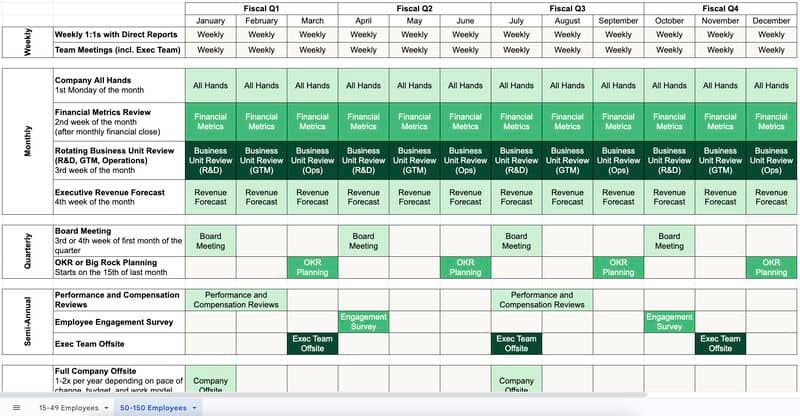
To facilitate annual compensation reviews, design your annual operating model so that you conduct a Total Rewards Survey 1-3 months before you do your annual compensation review.
 |
$19.00
Startup Operating Models
Things that just work when you're a small startup have a funny way of breaking when you hit the 50 employee mark. Strong... Read more |
This will help you have recent qualitative sentiment to combine with turnover data to understand if compensation is or is not creating risk in various segments of your employee population.
Keep in mind that average satisfaction with compensation is usually in the 40s. So, don't freak out if you're at 52, that's good.
Collecting anonymous demographic information in the survey can help you go deeper to understand risks created by policies.
For example, look at the answer for "I believe I will work at [Company name] two years from now" for women vs men ages 26-40 in Sales.
If your score for women of childbearing age is substantially lower, your parental leave and/or pro-rating (or lack thereof) for quota during leaves of absence might be driving high-performers out the door.
Determine Your Compensation Budget Framework with Finance
For most companies, the annual budget is set October to December for a January start to a new fiscal year.
This is the time that the Finance team determines what compensation-based changes are reflected in the budget (e.g., what line items, what %, how often).
For modeling, I like to use 3 categories: performance, market adjustments, and retention efforts. While these might ultimately be rolled up into a fewer or a single line item, it's helpful to project each as a unique category.
For performance, consider things like:
- Are we going to do performance-based merit increases? At what frequency? At what %? And, what % of the employee pool is eligible (e.g., tenure = 6+ months)? CPOHQ and other HR communities can be a good place to crowdsource the expected merit increase for the upcoming year. It's often 2-4%.
- How often will people get promoted? What % salary increase do we expect when someone gets promoted? Data from Pave suggests that 14% of US employees are promoted per year with an average increase of 10-15%.
- Do we allow off-cycle promotions? If so, what % of total promotions will that be? If you combine performance reviews and promotions, off-cycle promotions should be rare.
For market adjustments, consider:
- Are we going to do market adjustments (change salary tiers or bands based on macro-conditions changing the demand for labor)? This is most often done 1x per year, plus one-off reviews for emerging roles like AI or Forward Deployed Engineers. A Finance team will usually want an overall cap (e.g., 4%) even if some employees get more/less.
- Are we going to do Cost of Living Adjustments (COLAs)? This is a different version of a "market" adjustment based on inflation, not changes in supply/demand for a specific role. COLAs are much less common than HR folks seem to think!
- Are we going to have budget set aside for people below their comp tier/band? Employees can fall outside of salary bands if you adjust new hire salaries to market without changing the historical salaries, or if you're introducing tiers/bands for the first time.
- If you have an international workforce, how are you going to handle changes in currency conversion? Hyper-inflation? This one is tricky and depends on if you use market multipliers, where you hire, and more. But, have a plan.
For retention, consider:
- Are we going to offer signing bonuses? Under what conditions? To what % of new hires? The need for signing or sign-on bonuses can change a lot year to year and role to role, so it's good to research and reset periodically.
- Are we going to offer retention bonuses or give counter-offers? Retention bonuses are paid out to people who stay a specific period of time and counter-offers are often an increase in salary or bonus when a team member has received an external offer. The majority of people who accept counter-offers leave within 12 months anyway, so beware.
- How do you want your bonus plan(s) to work? Who is eligible? Are bonuses a % of base salary? For more on bonus design, listen to this podcast with me and Matt McFarlane of FNDN compensation consulting.
If you feel like you're struggling to answer these questions, you might need to start with a Compensation Philosophy instead.
The Information Finance Needs
Unless you are a compensation professional, the Finance team will likely help you model comp & benefits changes.
They will do a much better job with less back and forth if you give them:
- The date(s) or date range that a change takes effect
- Whether or not the change is one-time or recurring
- Whether the change is a $$ amount or a %
- What % of the employee pool is eligible, or the criteria (e.g., tenure = 6+ months)
- What lever drives the change (e.g., revenue, headcount, profit, utilization rate, etc.)
Here's a free template you can use to write out what you need, the assumptions you're making, and to give them the other details they'll need to start modeling.
If you're not comfortable reading formulas in Excel to understand what's happening in a model that gets shared with you to review, that's a skill to work on.
Even with the existence of AI, I truly believe HR professionals still need to know how to use COUNT and SUM formulas, VLOOKUPs, and other basic Excel/GoogleSheet formulas.
If I had $1 for every time I've seen an HR spreadsheet where numbers were hard-coded, or typed in, that wound up being wrong once I wrote formulas to auto-calculate, I'd have enough for many of my favorite ColdStone Dough For It! ice creams.
For some data sets, that's inconsequential. But, when you get into pro-rating payroll, calculating bonuses, and other items People people can be responsible for, it starts to get scary. Coursera and others offer a free Excel modeling class.
Closing Thoughts
If you found this helpful, stay tuned for next week's edition on how to think about benefits policies and model out the financial impact of benefits (a 5% vs 3% 401k match has BIG long-term consequences).
If you have questions, feel free to reply back to me or submit a question to be answered in a Dear People Person section of an upcoming newsletter.
Until next time,
Melissa