4 questions to budget for benefits with confidence
October 6, 2026 | Edition #32
Hello People person... Let's talk benefits.
When budgeting for benefits, what counts?
Your core categories for US employees are health, dental, and vision insurance, short- and long-term disability, life insurance, and paid-time off.
Common supplemental benefits include an equipment stipend, L&D stipend, parental leave, EAP, 401k, pension plans, and unique perks.
Depending on the stage of your start-up, you're also likely looking at equity incentives (aka stock options) in the form of ISOs, NSOs, or RSUs.
Plus, you'll have IT costs for issuing a laptop and covering certain apps/subscriptions per employee.
Your biggest cash-based cost here is usually health insurance, ranging from ~$10-30k per person per year—before splitting the employer/employee premium costs—depending on whether someone enrolls as an individual or with dependents.
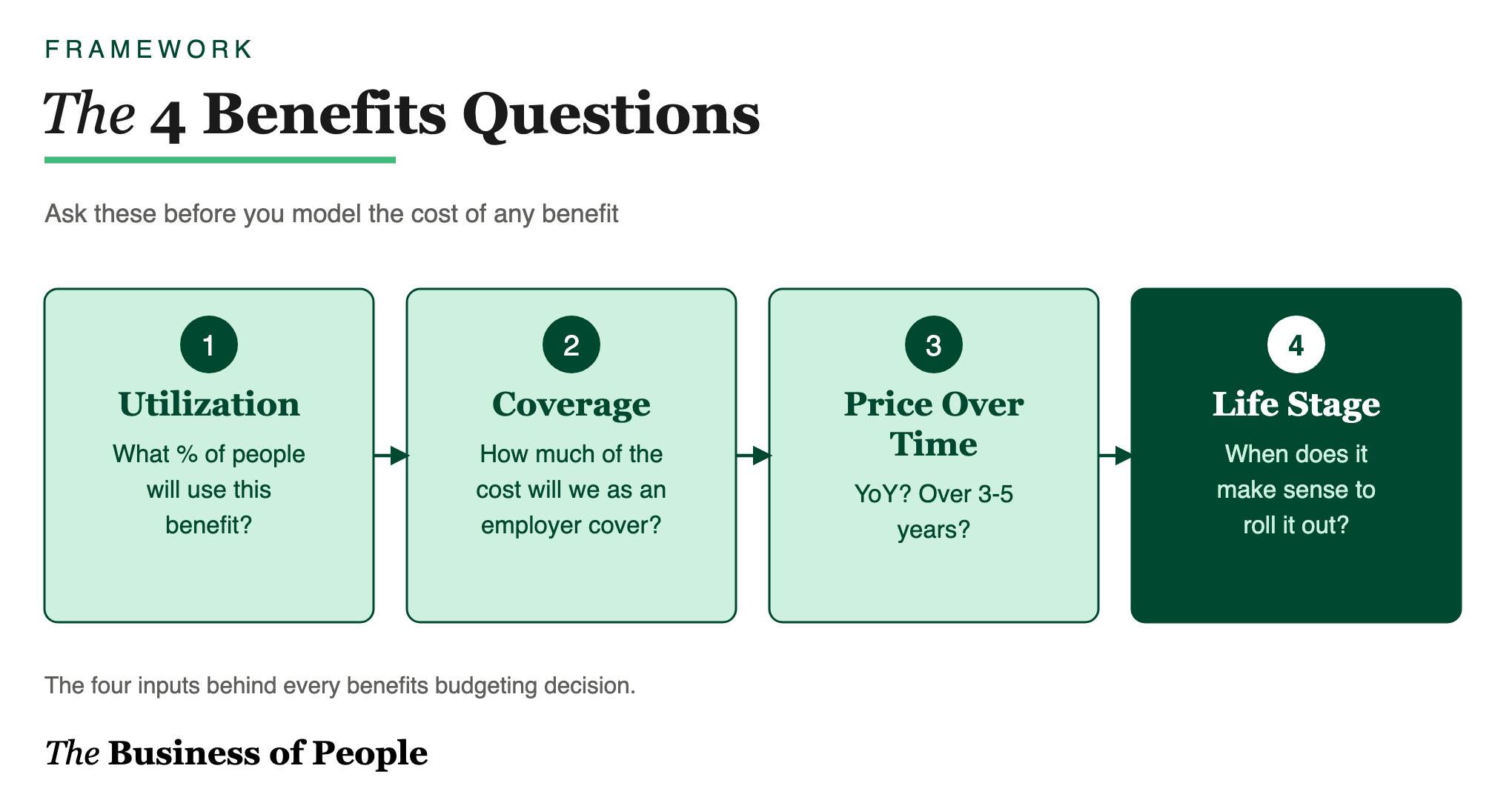
To budget for benefits, ask these three questions
We'll use healthcare as an example:
1) The utilization question: What % of your eligible US employee base will enroll in healthcare?
That's called the "take-up rate." According to recent research, the average take-up rate is 69.2%.
For budgeting, take the average expected cost per person (e.g., $15,000) and multiply it by the expected take-up rate.
If you budget for average cost per person x 100% of employees on non-mandatory benefits, your estimate will be too high.
You need to make assumptions about utilization, then update those YoY—or whenever your company does budgeting—to match reality.
2) The coverage question: What % or $$ amount of the premiums will we as an employer cover?
You can choose to cover a different % for individual employees, employee + spouse, employee + child, and families.
Or, you can give a $$ amount as a voucher of sorts that someone can apply to any plan.
When considering cost splits, remember that your business philosophy drives your talent philosophy and your talent philosophy drives your compensation philosophy (+ practices and policies).
If you're an early-stage startup that's a talent accelerator, you might choose to cover less whereas a highly-funded AI startup seeking experienced technical talent might choose to fund more.
The average amount covered for individuals for medical is 84% (source).
The average amount covered for families on medical and for anyone on dental/vision, is often substantially less (50-75%).
3) The price over time question: How much will the monthly premiums increase YoY?
This can range a lot from 4% to 30%+ depending on factors like your employee census, healthcare claims, and whether or not you're in a bundled group on a PEO. The average is around 8%, so I usually suggest budgeting 12% to have some buffer.
This same concept of how many people will utilize the benefit, how much will we cover, and how will costs increase over time can be applied to many benefits.
One additional question to consider for supplemental benefits
For non-core benefits, or things that help with talent acquisition and retention, but are not a baseline expectation, ask the life stage question:
When should we introduce this benefit?
Let's look at a common case.
You have 50 employees. They're asking for a 401k with a match as the #1 most desired benefit.
You have 18 months of runway and are default dead (need to fundraise again to continue to exist).
Do you rollout a 401k? Offer a match?
The answer to this depends on your company, but some factors to consider are:
1. When are 401ks typically rolled out at companies like ours? With matching?
Hint: Much later than most employees believe.
According to CPOHQ polls, 37% of startups with 100+ employees do not offer a 401k match.
You can, of course, rollout a 401k without a match much sooner, but the costs can still be $6-$10 dollars per person per month for administrative fees.
2. What is the most common match amount? How do we want to compare to peer companies?
For startups with <500 employees that offer a 401k match, 3.0% is the most common as a Safe Harbor match.
3. How do we want to increase benefits over time?
It is hard to roll benefits back because of employee blowback.
So, it often behooves you to slowly increase benefits over time as your company becomes more and more financially stable (e.g., finds product-market fit, becomes profitable, can forecast accurately).
With 100 employees at an average salary of $100,000 where the 401k is 90% utilized, a 3% match costs $270,000 and a 5% match costs $450,000. Over 5 years, assuming no change in headcount, that's a $900,000 difference in 401k matching costs. That 2% adds up!
If you want to avoid common benefits mistakes and be seen as a strategic leader, consider picking up this total rewards recommendations template.
 |
$10.00
Total Rewards Recommendations Template
A plug-and-play total rewards recommendations template for HR leaders who want to present a strategic pitch to their... Read more |
My answer to the common case:
For the hypothetical scenario I created above, knowing nothing else about the company or it's goals, I'd probably recommend rolling out a 401k with no match.
Then, setting a target for when to add a 3% match (e.g., when we hit $20M in revenue provided we have at least 5% EBITDA margin or 18+ months cash on hand).
Closing Thoughts
If you enjoyed this, forward it to another People person who'd benefit from it.
[My husband has me trying to improve my pun game, did I nail it or what?]
And, keep an eye out for next Tuesday's edition on how to design and model out an equity incentive program.
Until next time,
Melissa
